


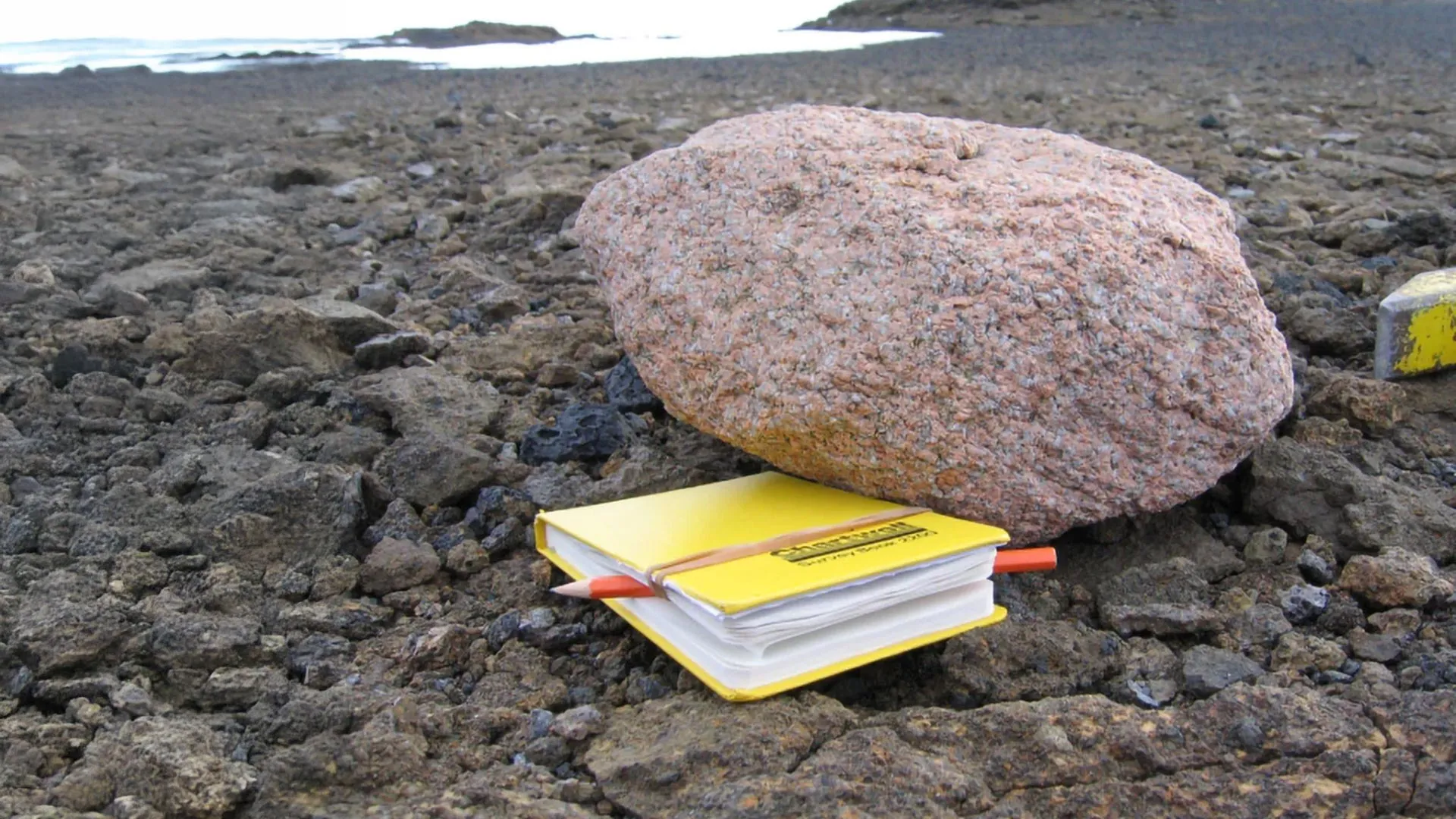
Bright pink granite boulders scattered across the dark volcanic peaks of the Hudson Mountains in West Antarctica have led scientists to a remarkable discovery. Beneath Pine Island Glacier lies an enormous buried granite mass, nearly 100 km wide and 7 km thick, roughly half the size of Wales in the UK.
For decades, these unusual rocks have puzzled researchers. Perched high on mountain ridges, they seemed out of place, raising questions about where they came from and what they might reveal about Antarctica’s past and future.
Dating Ancient Rocks From the Jurassic Period
A research team led by British Antarctic Survey (BAS) analyzed the granite by examining the radioactive decay of elements trapped inside tiny mineral crystals. This technique showed the rocks formed around 175 million years ago, during the Jurassic period.
Even with their age determined, their journey to the mountaintops remained unclear until scientists gathered new data from aircraft surveys over the region.
Airborne Surveys Reveal Buried Structure
Using highly sensitive gravity measurements collected by BAS’ Twin Otter aircraft and others, researchers detected an unusual signal beneath the glacier. The data matched what scientists would expect from a massive granite body hidden below the ice.
Connecting the surface boulders to this deep underground formation solved a long-standing mystery. It also revealed that Pine Island Glacier once moved very differently, pulling rocks from its base and carrying them uphill when the ice sheet was much thicker.
Clues to Ice Sheet Behavior and Sea Level Rise
This discovery provides important insight into how the glacier behaved during the last ice age (around 20 thousand years ago). By understanding past ice thickness and movement patterns, scientists can improve computer models used to predict how Antarctica’s ice sheets may respond to future climate change.
Dr. Tom Jordan, lead author and geophysicist at BAS, analyzed the airborne data. He said:
“It’s remarkable that pink granite boulders spotted on the surface have led us to a hidden giant beneath the ice. By combining geological dating with gravity surveys, we’ve not only solved a mystery about where these rocks came from, but also uncovered new information about how the ice sheet flowed in the past and how it might change in the future.”
Why Subglacial Geology Matters Today
The findings also highlight how the geology beneath Pine Island Glacier affects present-day conditions. This region has experienced some of the fastest ice loss in Antarctica in recent decades. The type of rock below influences how easily the ice slides and how meltwater moves underneath it.
Better understanding these processes will help refine models that estimate future sea level rise.
Rocks as Records of Antarctica’s History
Dr. Joanne Johnson, a co-author and geologist at BAS, collected the boulders during fieldwork in the Hudson Mountains as part of the International Thwaites Glacier Collaboration. She says:
“Rocks provide an amazing record of how our planet has changed over time, especially how ice has eroded and altered the landscape of Antarctica. Boulders like these are a treasure-trove of information about what lies deep beneath the ice sheet, far out of reach.
“By identifying their source, we have been able to piece together how they got to where they are today, giving us clues about how the West Antarctic Ice Sheet may change in future — information that is vital for determining the impact of sea level rise on coastal populations around the world.”
This research shows how combining geology and geophysics can uncover hidden features beneath Antarctica and deepen our understanding of the forces shaping the planet.