


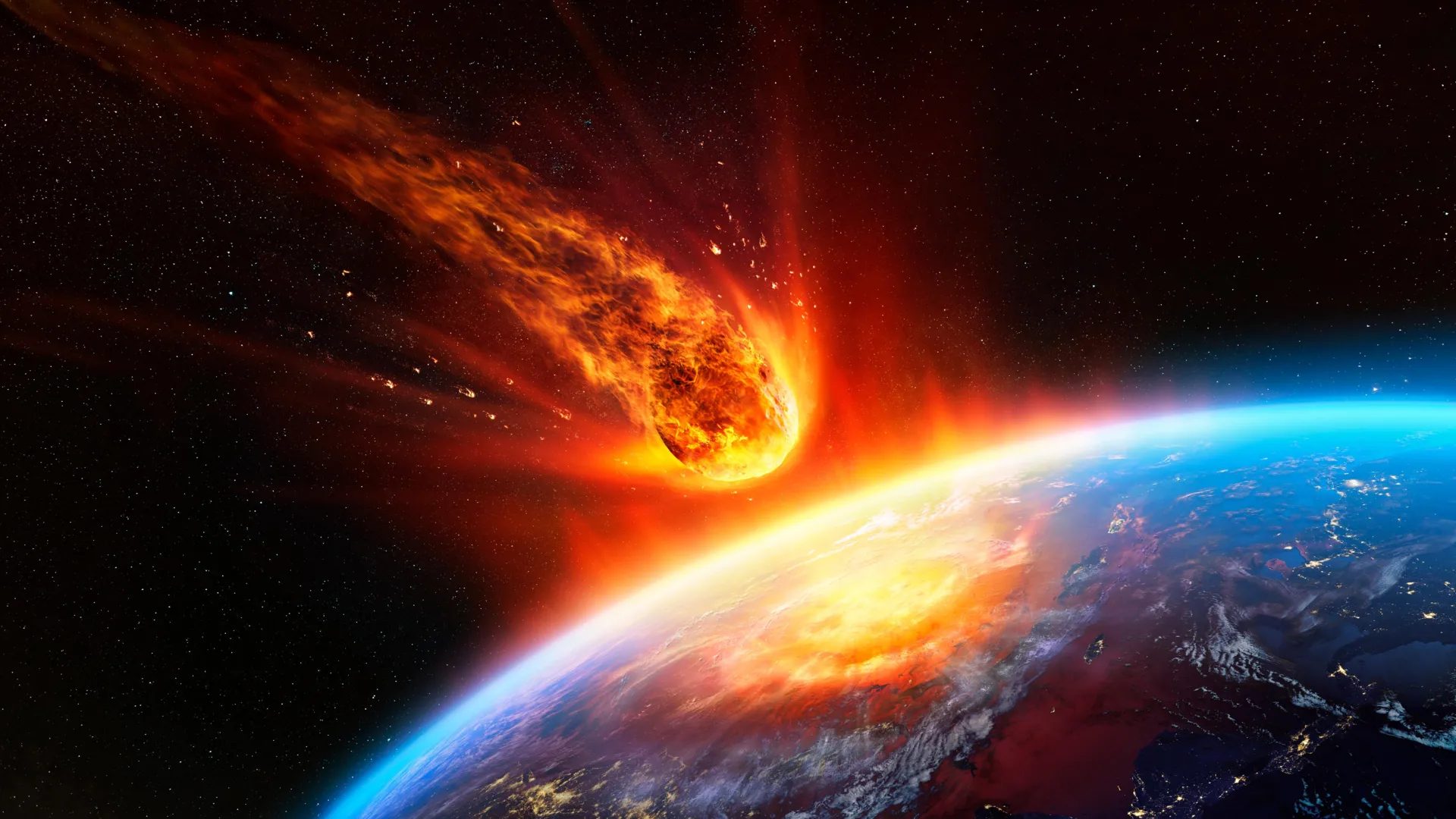
About 66 million years ago, a massive asteroid struck Earth and unleashed one of the most destructive events in the planet’s history. The impact ignited global fires, triggered dramatic climate shifts, and wiped out the dinosaurs along with countless other species. Yet new research suggests the catastrophe also opened the door for life to rebound far sooner than scientists once believed.
According to a study led by researchers at The University of Texas at Austin and published in Geology, new species of plankton emerged less than 2,000 years after the impact.
Chris Lowery, the study’s lead author and a research associate professor at the University of Texas Institute for Geophysics (UTIG) at the Jackson School of Geosciences, said this pace of evolution is extraordinarily fast compared with what scientists usually see in the fossil record. Normally, the formation of new species takes place over millions of years.
“It’s ridiculously fast,” said Lowery. “This research helps us understand just how quickly new species can evolve after extreme events and also how quickly the environment began to recover after the Chicxulub impact.”
Rethinking the Timeline of Life’s Recovery After the Chicxulub Impact
Earlier work by Lowery and colleagues studying the Chicxulub crater in the Gulf of Mexico had already shown that some surviving organisms returned to the region fairly quickly after the impact. Still, scientists generally believed that the first new species did not appear until tens of thousands of years later.
That estimate relied on the assumption that sediment built up at roughly the same rate after the extinction as it did beforehand. Researchers define the start and end of the mass extinction using a global geological layer formed from debris thrown into the atmosphere by the impact. This layer is known as the K/Pg boundary.
Lowery and his coauthors point out that this assumption overlooked major environmental changes that occurred when ecosystems collapsed on land and in the oceans. Massive die-offs altered how sediments accumulated in this boundary layer.
How Extinction Changed Sediment Accumulation
Many calcareous plankton species that normally sink to the ocean floor disappeared during the extinction event. At the same time, the loss of most plant life on land increased erosion, sending additional material into the oceans.
Together, these changes significantly affected how quickly sediments piled up in different regions. Because of this, relying only on sedimentation rates made it difficult to determine the true ages of tiny fossils preserved in these layers.
Helium-3 Isotope Reveals a More Precise Timeline
To refine the timeline, the researchers turned to previously published data involving an isotope marker found within the K/Pg boundary. This marker provides a more reliable way to measure the passage of time preserved in the geological record and allowed scientists to pinpoint when different plankton species first appeared in the fossil record.
The isotope, known as Helium-3, accumulates in ocean sediments at a steady rate. When sediment builds up slowly, higher concentrations of Helium-3 are present. When sediment accumulates more quickly, the concentration is lower. By measuring this isotope, scientists can more accurately estimate how much time passed as the sediments formed.
Using Helium-3 data from six K/Pg boundary locations in Europe, North Africa, and the Gulf of Mexico, the team calculated improved sedimentation rates. These measurements helped determine the age of sediments where a new plankton species, a foraminifera called Parvularugoglobigerina eugubina (P. eugubina), first appears in the fossil record. Scientists often use the emergence of P. eugubina as an indicator that ecosystems were beginning to recover after the extinction.
New Species Appeared Within Thousands of Years
The researchers determined that this plankton species evolved between 3.5 and 11 thousand years after the Chicxulub impact, though the exact timing varied depending on the site studied.
They also identified other plankton species that evolved during the same interval. Some of these appeared fewer than 2,000 years after the asteroid strike, marking the start of a long recovery that would gradually restore biodiversity over the next 10 million years.
“The speed of the recovery demonstrates just how resilient life is, to have complex life reestablished within a geologic heartbeat is truly astounding,” said Timothy Bralower, co-author of the paper and professor in the Department of Geosciences at Penn State University. “It’s also possibly reassuring for the resiliency of modern species given the threat of anthropogenic habitat destruction.”
A Rapid Burst of Evolution After Mass Extinction
The study suggests that between 10 and 20 new species of foraminifera appeared within roughly 6,000 years of the impact, although paleontologists still debate exactly which fossils represent distinct species.
Overall, the revised timeline shows that under the right conditions evolution can move remarkably quickly. Even after a catastrophic mass extinction, ecosystems can begin rebuilding within only a few thousand years, with new species emerging far sooner than scientists once thought.