


For years, researchers studying the Southern Ocean have pointed to one possible upside in an otherwise troubling climate outlook. A widely discussed idea known as iron fertilization proposed that as Antarctica warms and glaciers melt, iron trapped in the ice would be released into nearby waters. That iron would fuel blooms of microscopic algae, which absorb heat trapping carbon dioxide as they grow.
But new evidence suggests that expectation may not be accurate.
In what the team calls the most precise measurement so far of iron flowing from an Antarctic glacier, scientists from Rutgers University-New Brunswick found that meltwater from an ice shelf contributes far less iron to surrounding ocean waters than previously believed.
The study, published in Communications Earth and Environment, raises new questions about where iron in the Southern Ocean actually originates. According to the researchers, the results could influence how climate change forecasts and models are developed.
“It has been widely assumed that glacial melting underneath ice shelves contributes considerable bioavailable iron to these shelf waters, in a process of natural glacier-driven iron fertilization,” said Rob Sherrell, a professor in the Department of Marine and Coastal Sciences at the Rutgers School of Environmental and Biological Sciences and the study’s principal investigator.
Sherrell said the findings revise those assumptions. The amount of iron carried by meltwater is several times lower than earlier estimates. In addition, much of that iron appears to come from a different form of meltwater than the kind produced directly by melting ice shelves.
Why Iron in the Southern Ocean Matters
Even though Antarctic waters are dark for months at a time, the Southern Ocean supports abundant phytoplankton growth. These microscopic plants form the foundation of the food web, feeding krill that sustain penguins, seals, and whales. As phytoplankton grow, they remove large quantities of carbon dioxide from the atmosphere through photosynthesis, making this region the world’s largest oceanic sink for the climate warming gas.
Until now, much of what scientists understood about iron sources in these waters came from simulations and computer models. Sherrell and colleagues from Rutgers and partner institutions in the United States and the United Kingdom chose to gather direct field measurements instead.
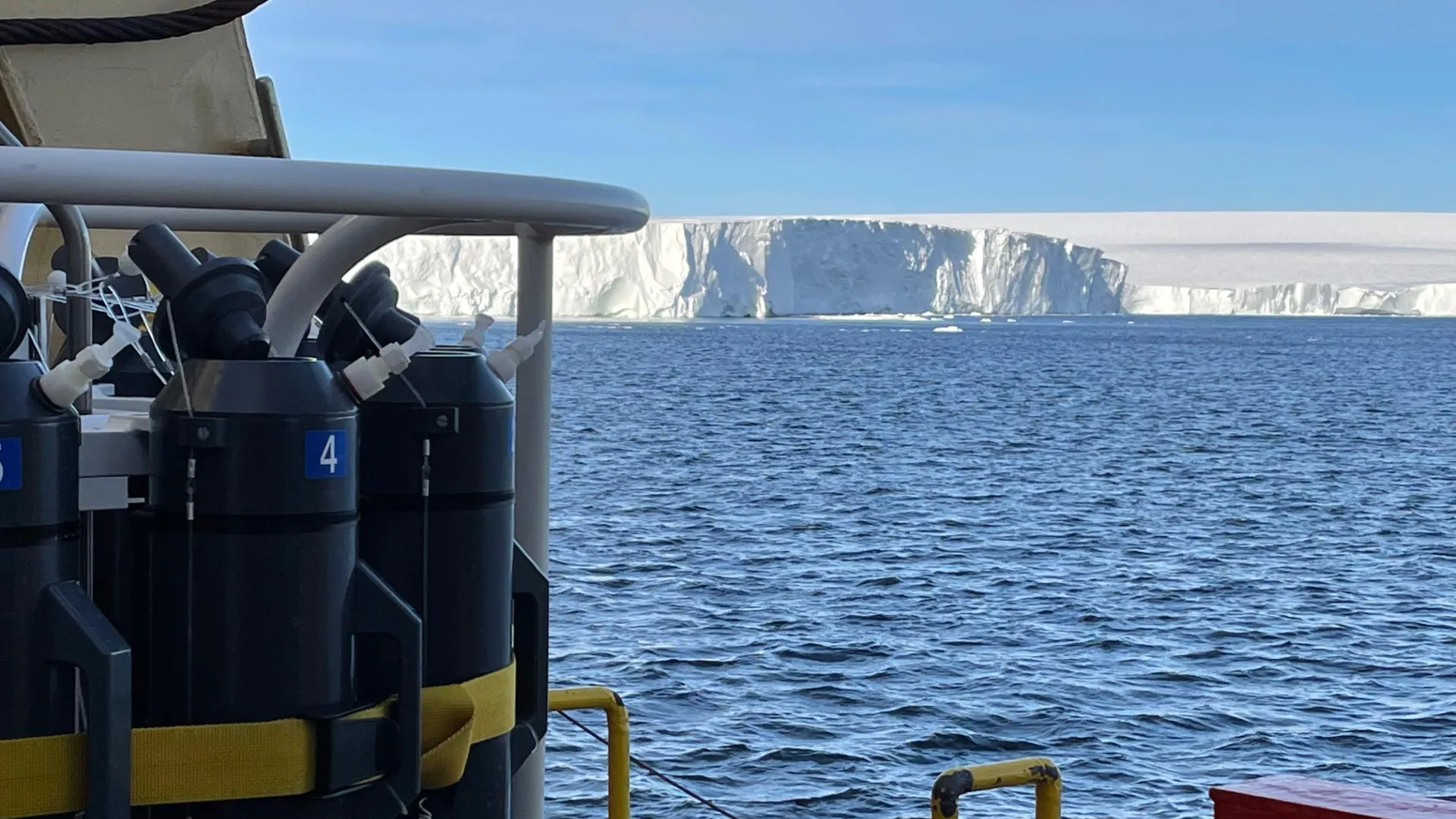
In 2022, the researchers traveled aboard the now-decommissioned U.S. icebreaker, the Nathaniel B. Palmer, to the Dotson Ice Shelf in the Amundsen Sea of West Antarctica. The Amundsen Sea accounts for most of the sea level rise driven by Antarctic melting. Their goal was to collect glacial meltwater at its source.
Sampling Beneath the Ice Shelf
In the Amundsen Sea, meltwater forms under floating ice shelves, which extend from glaciers on land into the ocean. The melting is driven mainly by relatively warm water from the deep ocean that flows into cavities beneath the ice.
At the Dotson Ice Shelf, the team located where seawater flows into one of these cavities and where it exits after mixing with meltwater. Water samples were taken at both entry and exit points.
Back in New Jersey, Venkatesh Chinni, a postdoctoral scholar and lead author of the study, measured iron concentrations in the samples, analyzing both dissolved iron and iron attached to suspended particles. Collaborators Jessica Fitzsimmons and Janelle Steffen at Texas A&M University examined isotopic ratios to “fingerprint” the iron and trace its origin. Steffen performed the initial isotopic analyses in the laboratory of Tim Conway at the University of South Florida.
Using these measurements, Chinni and the team calculated how much additional iron was present in water leaving the cavity compared with water entering it. The isotopic signatures also helped identify which melting processes were responsible.
Deep Water and Sediments Supply Most Iron
The results were unexpected, Sherrell said. Meltwater accounted for only about 10% of the dissolved iron flowing out of the cavity. Most of the iron came from deep ocean water (62%), while another 28% originated from sediments on the continental shelf.
“Roughly 90% of the dissolved iron coming out of the ice shelf cavity comes from deep waters and sediments outside the cavity, not from meltwater,” Chinni said.
The isotope data also point to processes occurring beneath the glacier itself. The samples suggest the presence of a liquid meltwater layer that lacks dissolved oxygen. Under such conditions, solid iron oxides in bedrock can dissolve more readily, releasing iron into the water. According to Chinni, this mechanism may contribute more iron than melting ice shelves do.
Rethinking Antarctic Iron and Climate Models
Together, these findings challenge long standing assumptions about iron sources in the Southern Ocean as the planet warms. The researchers emphasize that more work is needed to fully understand how subglacial processes influence iron release.
“Our claim in this paper is that the meltwater itself carries very little iron, and that most of the iron that it does carry comes from the grinding up and dissolving of bedrock into the liquid layer between the bedrock and the ice sheet, not from the ice that is driving sea level rise,” Sherrell said.
He added that many scientists may find this conclusion surprising.