


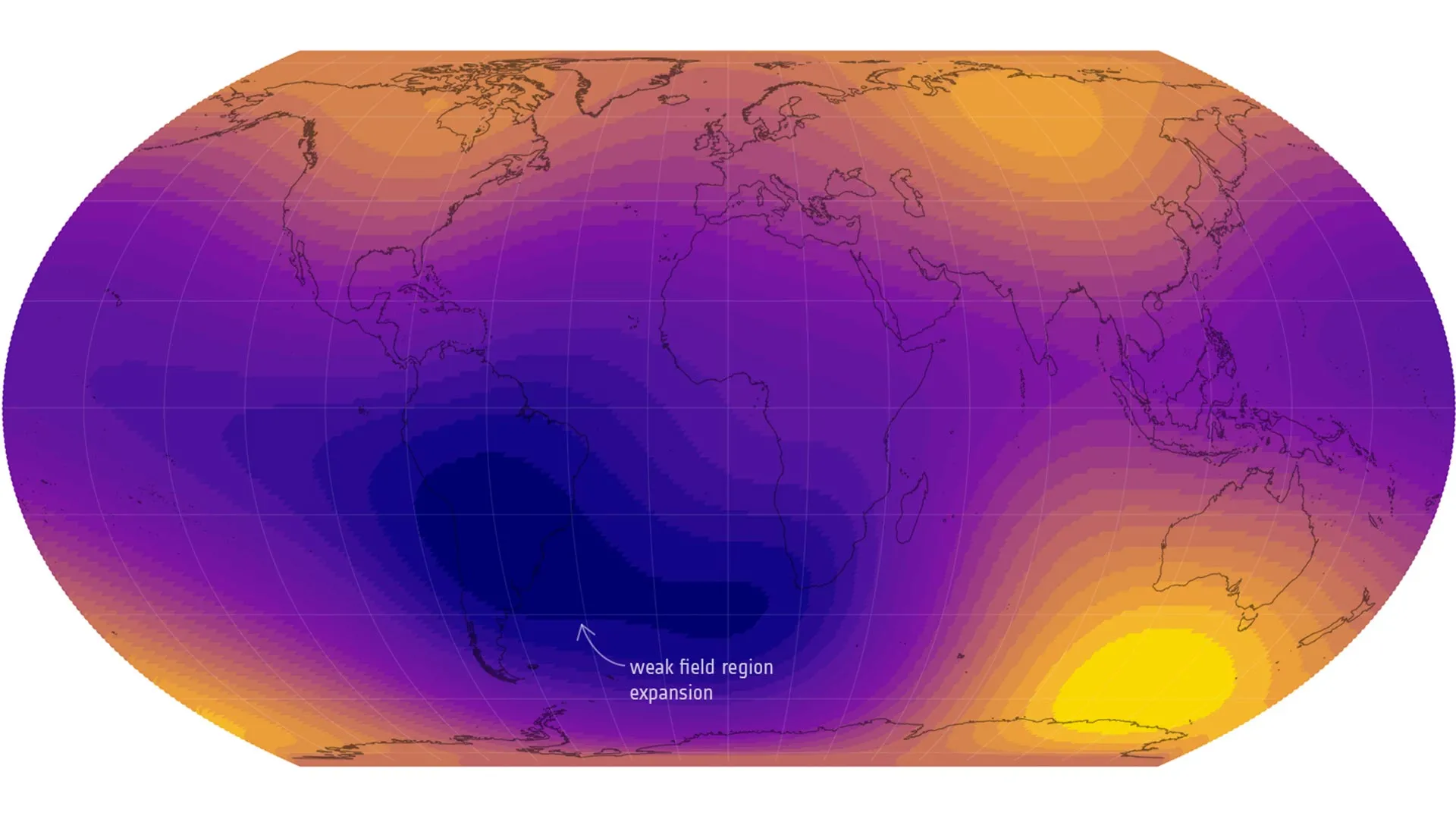
After analyzing 11 years of magnetic field data from the European Space Agency’s Swarm satellite constellation, researchers have found that a large weak zone in Earth’s magnetic field over the South Atlantic has grown dramatically. This region, called the South Atlantic Anomaly, has expanded since 2014 by an area nearly half the size of continental Europe.
Earth’s magnetic field plays a critical role in making the planet livable. It acts as a protective barrier, shielding us from harmful cosmic radiation and charged particles streaming from the Sun.
How Earth Generates Its Magnetic Field
The magnetic field is produced deep inside the planet. Roughly 3000 km below the surface, a vast ocean of molten, churning liquid iron fills the outer core. As this electrically conductive material moves, it generates electric currents. Those currents create the ever changing electromagnetic field that surrounds Earth. Although it can be loosely compared to the motion of a spinning conductor in a bicycle dynamo, the true processes driving the field are far more complicated.
Swarm is an Earth Explorer mission developed under ESA’s Earth Observation FutureEO program. It consists of three identical satellites that measure magnetic signals originating from Earth’s core, mantle, crust, and oceans, along with contributions from the ionosphere and magnetosphere.
These detailed observations help scientists separate the different sources of magnetism and better understand why the magnetic field is weakening in some regions while strengthening in others.
Why the South Atlantic Anomaly Matters
The South Atlantic Anomaly was first identified in the 19th century southeast of South America. Today it is closely monitored because of its implications for space safety. Satellites passing through this region are exposed to elevated levels of radiation, increasing the risk of technical malfunctions, hardware damage, and even temporary outages.
New findings published in Physics of the Earth and Planetary Interiors show that the anomaly expanded steadily between 2014 and 2025. Since 2020, however, an area of the Atlantic southwest of Africa has experienced even more rapid magnetic weakening.
“The South Atlantic Anomaly is not just a single block,” says lead author Chris Finlay, Professor of Geomagnetism at the Technical University of Denmark. “It’s changing differently towards Africa than it is near South America. There’s something special happening in this region that is causing the field to weaken in a more intense way.”
Reverse Flux Patches and Core Dynamics
Scientists link this unusual behavior to patterns in the magnetic field at the boundary between Earth’s liquid outer core and its solid mantle. These features, known as reverse flux patches, represent areas where the magnetic field behaves in an unexpected way.
Prof. Finlay explains, “Normally we’d expect to see magnetic field lines coming out of the core in the southern hemisphere. But beneath the South Atlantic Anomaly we see unexpected areas where the magnetic field, instead of coming out of the core, goes back into the core. Thanks to the Swarm data we can see one of these areas moving westward over Africa, which contributes to the weakening of the South Atlantic Anomaly in this region.”
Swarm Sets a New Magnetic Record
The latest magnetic field model marks an important milestone for Swarm. The mission now holds the longest continuous space based record of Earth’s magnetic field.
Launched on November 22, 2013, as the fourth Earth Explorer mission, the satellites were designed to test advanced Earth observation technologies. They have exceeded their planned lifetime and become essential for maintaining long term magnetic field records, supporting operational services, and guiding future satellite missions.
Swarm measurements form the foundation of global magnetic models used for navigation, tracking space weather hazards, and studying Earth’s system from its deep interior to the upper atmosphere.
Magnetic Field Strength Grows Over Siberia
The new results also highlight how dynamic Earth’s magnetism truly is. In the southern hemisphere, there is one region where the magnetic field is especially strong. In the northern hemisphere, there are two such areas, one near Canada and another over Siberia.
“When you’re trying to understand Earth’s magnetic field, it’s important to remember that it’s not just a simple dipole, like a bar magnet. It’s only by having satellites like Swarm that we can fully map this structure and see it changing,” said Prof. Finlay.
Since Swarm began operating, the magnetic field over Siberia has intensified while the field over Canada has weakened. The strong magnetic region over Canada has shrunk by 0.65% of Earth’s surface area, roughly the size of India. In contrast, the Siberian strong field region has expanded by 0.42% of Earth’s surface area, comparable to the size of Greenland.
These changes are driven by complex activity in Earth’s turbulent core and are connected to the gradual movement of the northern magnetic pole toward Siberia in recent years. This ongoing shift affects navigation systems, which depend on the balance between these strong magnetic regions.
ESA’s Swarm Mission Manager, Anja Stromme, said, “It’s really wonderful to see the big picture of our dynamic Earth thanks to Swarm’s extended timeseries. The satellites are all healthy and providing excellent data, so we can hopefully extend that record beyond 2030, when the solar minimum will allow more unprecedented insights into our planet.”