


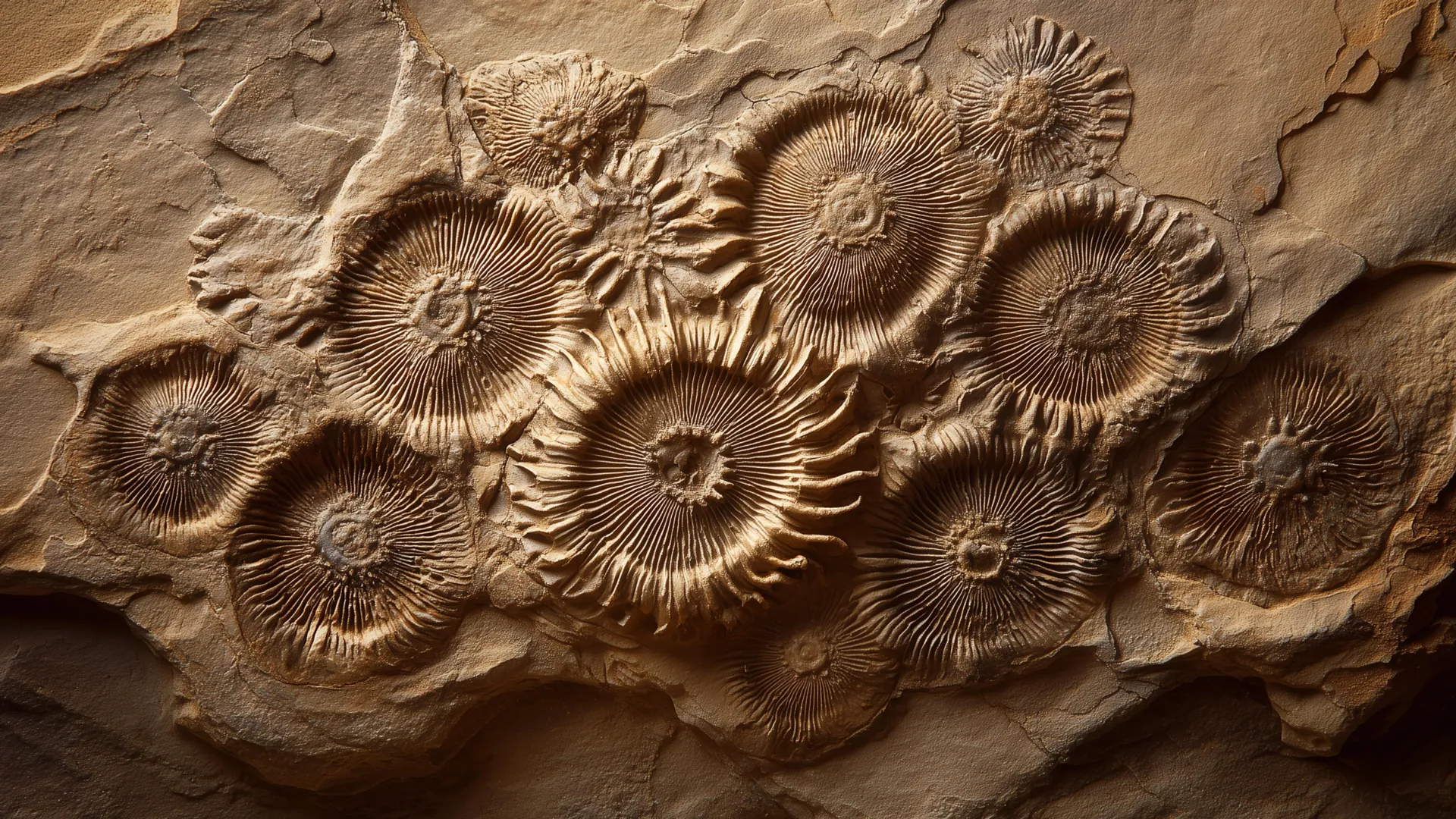
Creatures without hard shells or bones, such as jellyfish, almost never survive in the fossil record. Preservation becomes even more difficult in sandstone, a rock made of coarse grains that allow water to pass through easily and typically forms in turbulent environments shaped by waves and storms. These conditions usually erase delicate biological remains long before they can fossilize.
Yet roughly 570 million years ago, during a chapter of Earth history known as the Ediacaran period, something remarkable happened. Soft-bodied organisms living on the seafloor were buried by sand and preserved with extraordinary precision, leaving behind detailed fossil impressions that defy expectations.
The Global Mystery of the Ediacara Biota
Today, fossils of these organisms, collectively called the Ediacara Biota, have been discovered at sites around the world. Their unusual preservation has drawn intense interest from scientists, who want to understand how such fragile life forms were recorded so clearly in sandstone. Solving that puzzle could help clarify a major missing chapter in the history of large, visible life on Earth.
“The Ediacara Biota look totally bizarre in their appearance. Some of them have triradial symmetry, some have spiraling arms, some have fractal patterning,” says Dr. Lidya Tarhan, a paleontologist at Yale University. “It’s really hard when you first look at them to figure out where to place them in the tree of life.”
Life Before the Cambrian Explosion
These organisms lived only tens of millions of years before the Cambrian Explosion, a pivotal period that began about 540 million years ago and marked the rapid rise of complex and diverse animal life. For a long time, that event was thought to represent a sudden biological breakthrough. Increasingly, however, researchers see it as the culmination of a much longer buildup.
Tarhan describes this process as a “long fuse,” with the Ediacara Biota representing an important early phase in the gradual expansion of size, complexity, and ecological roles among animals.
New Clues From an Unusual Fossilization Process
Understanding how these organisms were preserved is essential for interpreting their place in evolution and for learning how early complex life emerged. A recent study led by Tarhan and her colleagues, published last month in the journal Geology under the title “Authigenic clays shaped Ediacara-style exceptional fossilization,” offers new insight into that process.
“If we want to understand the origins of complex life on Earth, the Ediacara Biota really occupies a critical point in that trajectory,” says Tarhan. “It’s incredibly important, not just for the Ediacara Biota but for all exceptionally preserved fossil assemblages, that we try to figure out what are the mechanisms behind that exceptional fossilization so we can better gauge to what extent these fossil assemblages provide a faithful reflection of life on the ancient sea floor.”
Tracing Fossils Through Lithium Isotopes
To investigate what happened during burial and fossilization, Tarhan’s team used an innovative chemical approach. They analyzed lithium isotopes in Ediacara fossils collected from Newfoundland and northwest Canada, studying specimens preserved in both sandy and muddy sediments.
These isotopes helped determine whether clay minerals played a role in fossilization and whether those clays came from land, known as detrital clays, or formed directly within the seafloor, known as authigenic clays.
How Ancient Seafloor Chemistry Preserved Soft Life
The results showed that detrital clay particles were already present in the sediment that covered the organisms. Those particles then provided surfaces where new clays could form directly within the seafloor. Fueled by silica-rich and iron-rich seawater and the unusual chemistry of Ediacaran oceans, these authigenic clays grew around the buried organisms.
In effect, the clays acted like a natural cement, binding sand grains together and preserving detailed outlines and impressions of soft tissues within sandstone.
Rethinking Why These Fossils Survived
This finding challenges the long-held idea that the Ediacara Biota were preserved because their bodies were unusually tough or chemically resistant. Instead, their survival in the fossil record appears to depend on environmental conditions rather than biological durability.
According to Tarhan and her colleagues, it was the chemistry of ancient seawater and sediments that made this exceptional preservation possible.
What This Means for the History of Life
Tarhan plans to apply the same lithium isotope method to fossils from other regions and time periods to see whether similar processes were at work elsewhere. Even now, the results provide a clearer view of Earth at a crucial moment in the evolution of animal life.
“It’s hard to overemphasize how dramatic of a change it is from the small and microbial life forms that dominate much of the Precambrian to the big step up in size and complexity,” seen in the Ediacara Biota and Cambrian Explosion, says Tarhan. “A clearer understanding of the processes responsible for fossilization across this interval will allow us to more robustly evaluate longstanding hypotheses for drivers of not only the appearance of the Ediacara Biota but also for their subsequent disappearance at the close of the Ediacaran period.”