


Scientists studying tiny feldspar crystals inside Australia’s oldest volcanic rocks have uncovered new clues about the early history of Earth’s interior, the formation of continents, and the origins of the Moon. These minerals act like time capsules, preserving chemical signals from billions of years ago.
The research was led by PhD student Matilda Boyce and involved scientists from UWA’s School of Earth and Oceans, the University of Bristol, the Geological Survey of Western Australia, and Curtin University. Their findings were published in Nature Communications.
Studying Some of the Oldest Rocks on Earth
The team focused on anorthosites that formed about 3.7 billion years ago and were collected from the Murchison region of Western Australia. These rocks are the oldest known on the Australian continent and rank among the most ancient rocks ever discovered on Earth.
“The timing and rate of early crustal growth on Earth remains contentious due to the scarcity of very ancient rocks,” Ms Boyce said.
To overcome this challenge, the researchers used high-precision techniques to examine untouched portions of plagioclase feldspar crystals. These areas preserve the isotopic “fingerprint” of Earth’s ancient mantle, offering a rare glimpse into conditions on the early planet.
When Earth’s Continents Began to Grow
The chemical evidence suggests that Earth’s continents did not start forming immediately after the planet took shape. Instead, significant continental growth appears to have begun around 3.5 billion years ago, roughly one billion years after Earth formed.
This timeline challenges long-standing assumptions about how quickly Earth developed its continents and provides new context for understanding the planet’s early evolution.
Linking Earth and the Moon’s Origins
The researchers also compared their results with data from lunar anorthosites brought back to Earth during NASA’s Apollo missions.
“Anorthosites are rare rocks on Earth but very common on the Moon,” Ms. Boyce said.
“Our comparison was consistent with the Earth and Moon having the same starting composition of around 4.5 billion years ago.
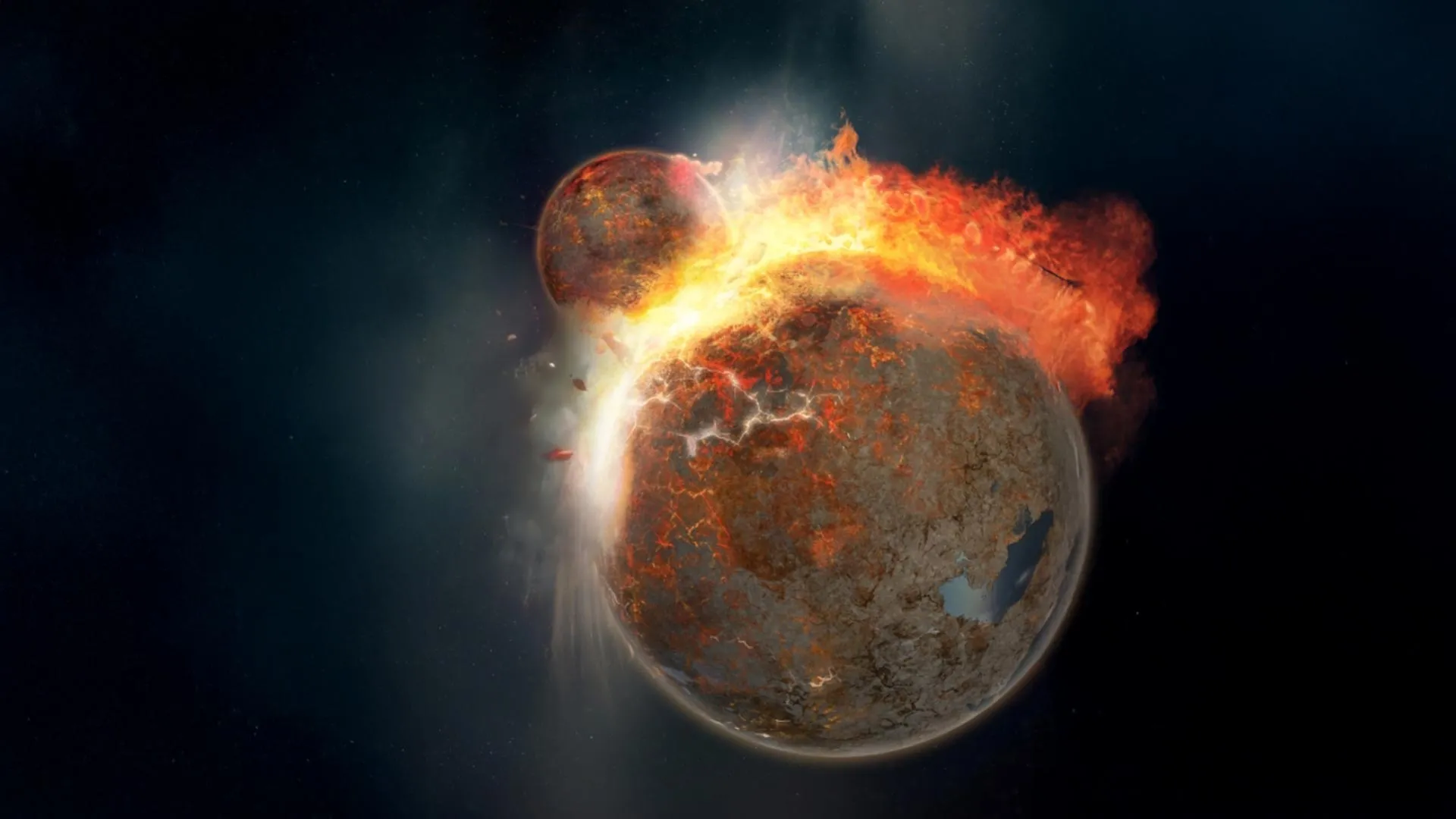
“This supports the theory that a planet collided with early Earth and the high-energy impact resulted in the formation of the Moon.”
The study was supported by funding from the Australian Research Council.